

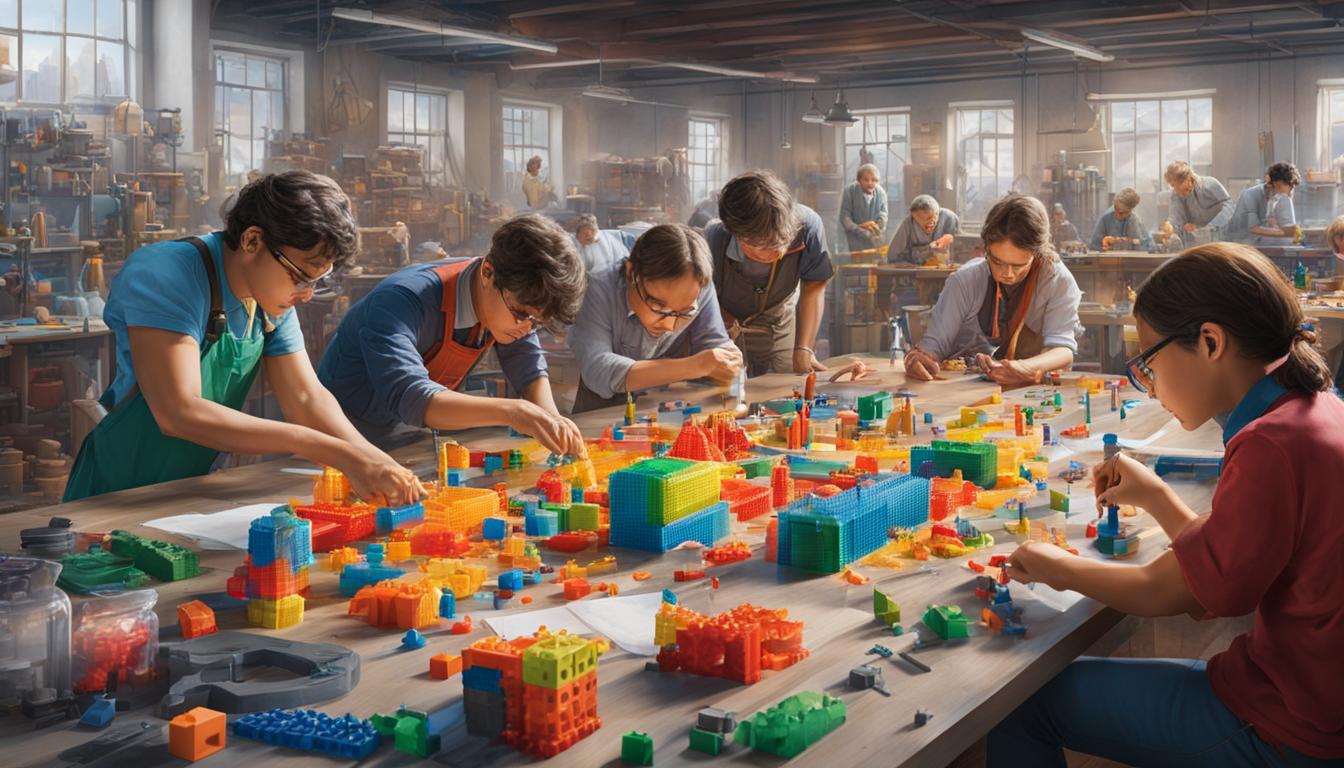
LEGOs have become a beloved toy for children and adults around the world. Every masterpiece created with these iconic bricks tells a story of creativity, imagination, and boundless possibilities. But have you ever wondered when this incredible journey began?
The history of LEGOs can be traced back to the early 1930s, when Danish carpenter Ole Kirk Kristiansen founded the LEGO Group. Initially, the company focused on producing wooden toys, including cars and airplanes, with a commitment to quality craftsmanship and the belief in the power of play.
With their humble beginnings in a small carpentry shop, LEGO underwent a remarkable transformation that propelled them to become one of the world’s leading toy manufacturers. Let’s delve into the captivating story of LEGO’s evolution, innovation, and enduring impact on playtime.
Key Takeaways:
- The origin of LEGOs can be traced back to Danish carpenter Ole Kirk Kristiansen in the early 1930s.
- LEGO initially focused on producing wooden toys, emphasizing high-quality craftsmanship and the importance of play.
- LEGO’s journey from wooden toys to the iconic LEGO bricks showcases their commitment to innovation and creativity.
- LEGOS have become more than just toys; they are tools for education, mediums for art, and bridges that connect people across diverse backgrounds.
- The legacy of LEGO is one of resilience, imagination, and the enduring power of play.
The Birth of LEGO: Wooden Toys and Family Support
In the midst of the global economic crisis, Ole Kirk Kristiansen, the founder of LEGO, embarked on a remarkable journey that would shape the future of toys. It was during the uncertain times of the early 1930s when Kristiansen took a bold step and started producing wooden toys, despite the prevailing challenges.
LEGO, originally a carpentry shop in Denmark, began crafting a range of wooden toys in 1932, including cars, airplanes, and yo-yos. This marked the humble beginnings of a company that would later revolutionize the toy industry. Kristiansen’s dedication to craftsmanship and quality set the foundation for what would become a global phenomenon.
However, the path to success was not without obstacles. Kristiansen faced skepticism from his family, who questioned whether the venture would thrive in such challenging times. Undeterred, he persisted and secured a loan to support his vision for the future of the company.
The LEGO Group’s first product line, introduced in 1932, showcased the innovative spirit and commitment to play that would define the brand. It was a testament to Kristiansen’s unwavering determination and his belief in the power of imaginative play for children.
The LEGO Name and the Values Behind It
In 1935, Ole Kirk Kristiansen made a significant decision that would shape the future of his company. He changed the name from its original form to LEGO, derived from the Danish words “leg godt,” which translates to “play well.” This name change was more than just a rebranding; it encapsulated the core values and philosophy of the company.
Ole Kirk Kristiansen firmly believed in providing children with high-quality toys that would bring them joy and enable them to engage in meaningful play. The LEGO name became synonymous with these values, reflecting the commitment to excellence and the pursuit of creating toys that would stand the test of time.
The LEGO philosophy can be summed up in their motto, “Only the best is good enough.” This guiding principle underscores the company’s commitment to delivering products of exceptional quality, craftsmanship, and durability. From the selection of the finest materials to the strict quality control measures, every aspect of LEGO’s production process reflects this unwavering dedication to excellence.
“We have a responsibility that goes far beyond the products we offer. We have a responsibility for the children of the world.”
The LEGO name has become synonymous with creativity, innovation, and imagination. It represents a brand that has captivated the hearts and minds of millions, transcending age and cultural boundaries. LEGO sets have become treasured artifacts, cherished for their ability to inspire and engage individuals in endless hours of building, storytelling, and exploration.
As LEGO continues to evolve and adapt to the changing landscape of play, the core values behind the LEGO name remain steadfast. LEGO remains committed to fostering learning, creativity, and imagination through their products, ensuring that children and adults alike can continue to experience the joy and limitless possibilities that LEGO has to offer.
Innovations and Technological Advances
Ole Kirk Kristiansen, the visionary behind LEGO, was always on the lookout for new technology and machinery to enhance toy production. His commitment to innovation led him to make a significant investment in the mid-1930s—the purchase of the company’s first milling machine. This acquisition marked a pivotal moment in LEGO’s history, showcasing Kristiansen’s foresight and his determination to continually improve the quality and efficiency of their toys.
With the advent of new technology, tools, and materials, LEGO was able to revolutionize their manufacturing processes and deliver a superior toy experience. The introduction of state-of-the-art machinery enabled precision and consistency in production, allowing LEGO to create intricate designs and intricate details that captivated children and adults alike.
“The purchase of our first milling machine was a game-changer for us. It allowed us to push the boundaries of what was possible, ensuring that our toys were not only fun to play with but also beautifully crafted.” – Ole Kirk Kristiansen
As LEGO embraced new technology, their toy production flourished. The incorporation of advanced machinery streamlined manufacturing processes, resulting in greater productivity and shorter production times. By optimizing their operations, LEGO was able to meet the growing demand for their products and expand their reach to a wider audience.
Furthermore, the introduction of innovative materials opened up a world of creative possibilities for LEGO. From the iconic plastic bricks to specialized pieces and accessories, the integration of new materials enabled the creation of more intricate designs and realistic details.
| Key Technological Advances | Impact on Toy Production |
|---|---|
| Incorporation of the first milling machine | Enhanced precision and craftsmanship |
| Utilization of advanced machinery | Improved production efficiency and shorter turnaround times |
| Introduction of innovative materials | Expanded creative possibilities and realistic designs |
The commitment to innovation and technological advancement has always been at the core of LEGO’s success. By embracing new technology, LEGO continues to push the boundaries of what is possible in toy production, inspiring imagination and creativity in generations of children around the world.
LEGO’s Resilience During World War II
Despite the challenges of World War II, LEGO demonstrated remarkable resilience and adaptability, experiencing an unexpected boost in production and demand for their toys. Import activities came to a halt, leading to a surge in the sale of Danish wooden toys, including LEGO products. Amidst the turmoil of the war, LEGO managed to bring joy and entertainment to children around the world.
During this critical period, LEGO’s commitment to quality and craftsmanship shone through, earning them a reputation for producing exceptional wooden toys. The company’s dedication to creating toys that provided both fun and educational value contributed to their continued success.
Boost in Danish Wooden Toy Production
The cessation of imports created a significant opportunity for Danish toy manufacturers, including LEGO, to meet the increasing demand for toys. Danish wooden toys gained popularity due to their durability, timeless appeal, and superior quality.
The boost in Danish wooden toy production during WWII allowed LEGO to cement its position as a prominent player in the industry. The company’s commitment to delivering exceptional play experiences, even in the midst of global conflict, showcased their determination to bring joy to children.

“LEGO’s ability to thrive during World War II demonstrated the resilience and adaptability of the company. Despite the challenging circumstances, LEGO continued to innovate and deliver high-quality toys, providing a source of joy for children.”
LEGO’s successful navigation through the difficulties faced during World War II set the stage for their future growth and development. The company’s commitment to creativity and resilience during this period laid the foundation for the iconic LEGO bricks that would revolutionize the toy industry and inspire generations to come.
The Fire and Rebuilding of LEGO
In 1942, a devastating fire swept through the LEGO factory, threatening Ole Kirk Kristiansen’s life work. This catastrophic event could have spelled the end of the LEGO Group, but with unwavering determination, Kristiansen refused to let the flames define his legacy.

Supported by his dedicated family and loyal employees, Kristiansen made the bold decision to rebuild the LEGO factory. The rebuilding process took place in the same location, a symbolic testament to his resilience and commitment to the craft.
To finance the reconstruction, Kristiansen turned to Vejle Bank and secured a loan. With this financial assistance, the LEGO Group was able to construct their first dedicated toy factory, a facility that showcased their vision and ambition in the face of adversity.
By the end of the same year, production resumed at the rejuvenated LEGO factory, marking a pivotal moment in the company’s history. The fire may have brought destruction, but it also brought forth an opportunity for rebirth and renewal.
“The fire was devastating, but it did not burn our spirit. We emerged from the ashes stronger than ever,” Kristiansen later remarked, reflecting on the ordeal.
“The fire was devastating, but it did not burn our spirit. We emerged from the ashes stronger than ever.” – Ole Kirk Kristiansen
Rebuilding the LEGO Factory: A Triumph of Perseverance
The fire and subsequent rebuilding of the LEGO factory encapsulate the indomitable spirit of the LEGO Group. It is a story of resilience, perseverance, and unwavering dedication to the craft of toy making.
This chapter in the LEGO Group’s history is a testament to their unwavering commitment, not only to the production of high-quality toys but also to the values they uphold. Despite the destruction caused by the fire, the LEGO Group was determined to continue creating joy and inspiring creativity in children around the world.
| Year | Event |
|---|---|
| 1942 | Fire destroys the LEGO factory |
| 1942 | Rebuilding of the LEGO factory in the same location |
| 1942 | Construction of the first dedicated toy factory |
| 1942 | Production resumes at the LEGO factory |
The Evolution of LEGO Bricks
Throughout the 1950s, LEGO focused on refining their designs and improving the functionality of their bricks. Their dedication to innovation led to the introduction of the groundbreaking stud-and-tube locking system in the late 1950s, revolutionizing LEGO play.
The stud-and-tube locking system enabled secure connections between bricks while allowing for easy disassembly. This advancement opened up a world of possibilities, allowing builders to create endless combinations and constructions. The system created a strong bond between bricks, ensuring stability and durability in each creation.
This evolution in LEGO brick design greatly enhanced the versatility and play value of LEGO sets. With the new locking system, builders could construct intricate structures, vehicles, and even entire landscapes with ease. The improved functionality sparked imaginations and encouraged creative thinking among LEGO enthusiasts of all ages.
“The introduction of the stud-and-tube locking system was a game-changer for LEGO. It allowed for more complex and sturdy builds, giving builders the confidence to explore new ideas and push the boundaries of their creativity.” – LEGO enthusiast
As LEGO continued to refine their brick designs, they expanded the range of colors, sizes, and specialized elements. This constant evolution led to the development of themed sets, such as LEGO City, LEGO Star Wars, and LEGO Technic, offering builders even more opportunities for imaginative play and storytelling.
Today, the stud-and-tube locking system remains a fundamental aspect of LEGO play. It is a testament to the enduring design and engineering principles that have made LEGO bricks one of the most beloved toys worldwide.
| Advantages of the Stud-and-Tube Locking System | Benefits for Builders |
|---|---|
| Secure connections between bricks | Allows for complex and sturdy builds |
| Easy disassembly | Encourages endless creativity and experimentation |
| Durable construction | Ensures long-lasting play value |
| Versatility in building options | Inspires imaginative storytelling and play |
The Patent and Global Expansion
In 1958, LEGO obtained a patent for their modern brick design, solidifying their position as a leader in the toy industry.
This patent ensured the compatibility of bricks across different generations, showcasing the timeless nature of LEGO’s vision.
As LEGO expanded globally, their bricks became a cultural touchstone, transcending borders and fostering creativity in children and adults worldwide.
“LEGO bricks have become a symbol of imagination and endless possibilities.”
The patent for the LEGO brick design was a significant milestone in the company’s history, furthering their commitment to innovation and quality.
The global expansion of LEGO introduced their iconic bricks to children and enthusiasts worldwide, creating a shared language of creativity.
The LEGO brick patent laid the foundation for the company’s ongoing success and enduring popularity.
Influence Across Borders
The global expansion of LEGO brought the joy of building and play to millions of children, regardless of their location or background.
By transcending borders, LEGO became a unifying force, encouraging collaboration, problem-solving, and imaginative thinking.
LEGO sets became a common language, connecting people of different cultures through the universal language of creativity.
“Building with LEGO bricks sparks creativity and fosters a sense of possibility and achievement in both children and adults.”
Relevant Table: LEGO’s Global Expansion
| Year | New International Markets |
|---|---|
| 1961 | United States |
| 1963 | United Kingdom |
| 1973 | Australia |
| 1985 | Canada |
| 1987 | China |
LEGO’s Successes and Challenges
In 2004, LEGO faced a severe financial crisis brought on by overexpansion and diversification. This crisis forced the company to reassess its strategy and refocus on its core products, particularly the iconic LEGO bricks. By streamlining their product line and returning to their roots, LEGO was able to successfully navigate the challenges and reclaim its position as a leader in educational and creative play.
The LEGO Financial Crisis
The LEGO financial crisis of 2004 was a pivotal moment for the company. After years of rapid expansion and experimentation with new product lines, LEGO found itself in a precarious situation. Sales were declining, and the company was burdened with excessive debt and costly inventory. It was clear that decisive action was needed to turn things around.
With a renewed focus on their core products, LEGO embarked on a comprehensive restructuring effort. This involved divesting non-essential businesses, reducing the number of product lines, and cutting costs across the organization. By refocusing on what they did best—creating and selling LEGO bricks—the company aimed to rebuild its financial stability and reconnect with its target audience.
Refocusing on Core Products
LEGO’s refocus on core products proved to be a strategic turning point. By concentrating their efforts on the beloved LEGO bricks, the company reaffirmed its commitment to quality, creativity, and imaginative play. This move allowed LEGO to tap into its inherent strengths and reestablish itself as a trusted brand for children, parents, and educators.
By streamlining their product line, LEGO was able to allocate more resources towards innovation, design, and marketing for their core products. This investment paid off, as new LEGO sets and collections captured the attention of both new and existing fans. The company’s commitment to quality and attention to detail ensured that each LEGO brick continued to provide hours of imaginative play and educational value.
LEGO’s Road to Recovery
“Returning to our core products, and embracing the timeless fun and creativity of LEGO bricks, was essential in our journey to recovery. It allowed us to reconnect with our customers and reinforce what makes LEGO so special.”
LEGO’s refocusing on core products not only helped the company overcome its financial crisis but also reignited its growth and popularity. The reintroduction of classic LEGO sets and themes, along with innovative new additions, attracted a new generation of children and adults alike. LEGO once again became synonymous with imaginative play, problem-solving, and the limitless possibilities of building with bricks.
| LEGO’s Successes | LEGO’s Challenges |
|---|---|
| Reestablished themselves as a leader in educational and creative play | Severe financial crisis due to overexpansion and diversification |
| Revitalized their core product line with innovative sets and collections | Declining sales and excessive debt |
| Recaptured the attention of both new and existing LEGO fans | Costly inventory and bloated product offerings |
| Reconnected with customers and reinforced the LEGO brand | Loss of focus on core products and target audience |
LEGO’s ability to overcome the financial crisis and refocus on their core products stands as a testament to their resilience and commitment to quality. Through strategic decision-making, innovation, and a return to their roots, LEGO reestablished itself as a beloved brand that continues to inspire creativity and imagination in millions of children worldwide.
LEGO’s Impact on Creativity and Culture
LEGO bricks have had a profound impact on creativity and imaginative play, transcending generations and cultures. They have become more than just toys, serving as tools for education, mediums for art, and a universal language connecting people across diverse backgrounds.
LEGO sets have become cultural artifacts, treasured for their innovation and the endless possibilities they offer to dream, build, and create. Through the act of construction, individuals can unleash their creativity, explore different ideas, and problem-solve. The act of playing with LEGO sparks imagination and encourages out-of-the-box thinking, cultivating essential skills for personal and intellectual growth.
LEGO’s impact on culture is undeniable. It has become a cultural touchstone, ingrained in society’s collective consciousness. From household names like LEGO Star Wars and LEGO Harry Potter to architectural replicas and collaborations with popular franchises and artists, LEGO has become deeply intertwined with popular culture, influencing movies, books, and even museum exhibits.
“Building with LEGO bricks is a captivating experience that encourages resourcefulness and fosters a sense of accomplishment. It allows individuals to express themselves, communicate ideas, and tell stories, creating a shared language that connects people of all ages and backgrounds.”
Furthermore, LEGO’s commitment to inclusivity and diversity in its product offerings has helped it become a powerful tool for social change. The company has introduced sets featuring female scientists, diverse characters, and global landmarks, promoting representation and encouraging children to see themselves in the world of LEGO.
Whether it’s constructing a spaceship or reimagining a famous landmark, LEGO’s impact on creativity and culture goes beyond the confines of traditional toys. It has become a symbol of limitless possibilities, fostering innovation, storytelling, collaboration, and playfulness in individuals of all ages.
The Legacy of LEGO
The legacy of LEGO is a testament to its enduring popularity and the lasting impact it has had on generations of children and adults alike. From its humble beginnings in a small carpentry shop in Denmark, LEGO has grown into one of the largest and most beloved toy manufacturers in the world. Its success is not only attributed to its innovative products but also to its commitment to promoting learning through play.
LEGO’s enduring popularity can be seen in the millions of people who have been inspired by the brand to unleash their creativity and imagination. The timeless appeal of LEGO bricks transcends age, gender, and cultural boundaries, making it a universal language of play. LEGO sets have become more than just toys—they have become cultural artifacts, treasured for their ability to spark creativity and bring people together.
The legacy of LEGO is also one of resilience. Throughout its history, LEGO has faced challenges, such as the devastation caused by a fire in their factory in 1942 and a financial crisis in 2004. However, through determination and adaptability, LEGO has always managed to overcome these obstacles and emerge stronger than before. It is this resilience that has allowed the brand to thrive and continue to innovate in the ever-evolving toy industry.
“LEGO is a symbol of the power of imagination, creativity, and play. It has the ability to inspire and engage people of all ages, encouraging them to think outside the box and build something extraordinary.”
In addition to its impact on individuals, LEGO’s legacy can also be seen in the larger context of educational and cultural institutions. LEGO has been embraced by educators as a valuable tool for promoting critical thinking, problem-solving, and teamwork skills. Its incorporation in classrooms and learning environments has transformed the way children learn and engage with subjects such as science, technology, engineering, and mathematics. LEGO’s influence on creativity and innovation extends beyond the realm of education, with the brand recognized and celebrated in art exhibits, museums, and pop culture.
The Enduring Impact of LEGO:
- Inspires creativity and imagination
- Encourages problem-solving and critical thinking
- Fosters collaboration and teamwork
- Promotes learning through play
- Transcends age, gender, and cultural boundaries
- Part of cultural institutions and exhibits
LEGO’s legacy is not limited to its past achievements but continues to shape the future of play. With continual innovation and a commitment to quality, LEGO remains a trusted brand that brings joy and inspiration to millions around the world. As the legacy of LEGO evolves, one thing remains certain—the enduring power of play and the legacy it leaves behind.
Conclusion
LEGO’s journey from wooden toys to the iconic LEGO bricks is a testament to the power of innovation and the importance of play in our lives. For generations, the company has been devoted to providing children and adults alike with toys that inspire creativity and imagination.
LEGO’s impact on playtime cannot be overstated. The versatile LEGO bricks have allowed individuals to build, design, and create to their heart’s content, fostering critical thinking skills, problem-solving abilities, and spatial awareness. LEGO sets have become a staple in homes, classrooms, and even art galleries, bridging the gap between education, entertainment, and culture.
As the world continually evolves, LEGO remains dedicated to adapting and expanding its offerings. From innovative new sets to digital experiences, LEGO continues to push the boundaries of play, inviting individuals of all ages to engage in meaningful, immersive, and imaginative play experiences. With its enduring popularity, LEGO shows no signs of slowing down on its mission to provide endless hours of fun and learning.
FAQ
When did LEGOs begin?
LEGO’s origins can be traced back to Danish carpenter Ole Kirk Kristiansen, who started the LEGO Group in the early 1930s.
What were the first products produced by LEGO?
The LEGO Group initially focused on producing wooden toys, such as cars and airplanes.
How did LEGO get its name?
In 1935, Ole Kirk Kristiansen changed the company’s name to LEGO, derived from the Danish words “leg godt” (meaning “play well”).
What values did LEGO emphasize?
LEGO emphasized quality and enjoyable play for children. The company’s motto, “Only the best is good enough,” further emphasized their commitment to quality.
How did LEGO innovate in toy production?
In the mid-1930s, Ole Kirk Kristiansen purchased his first milling machine, demonstrating his commitment to innovation and improving the quality and efficiency of toy production.
How did LEGO survive during World War II?
LEGO experienced increased demand for toys during World War II as import activity was halted, favoring the sale of Danish wooden toys, including LEGO products.
What happened to LEGO during a fire?
In 1942, a fire destroyed the LEGO factory. However, with the support of his family and employees, Ole Kirk Kristiansen made the decision to rebuild the factory in the same location.
How did LEGO improve the functionality of their bricks?
In the late 1950s, LEGO introduced the stud-and-tube locking system, a groundbreaking development that allowed for secure connections between bricks and easy disassembly.
When did LEGO obtain a patent for their modern brick design?
LEGO obtained a patent for their modern brick design in 1958, ensuring the compatibility of bricks across different generations.
How did LEGO recover from a financial crisis?
In 2004, LEGO focused on core products, including the iconic LEGO bricks, which helped them recover from a severe financial crisis caused by overexpansion and diversification.
What impact has LEGO had on creativity and culture?
LEGO bricks have had a profound impact on creativity and culture, becoming tools for education, mediums for art, and a universal language connecting people across diverse backgrounds.
What is the legacy of LEGO?
LEGO’s legacy is one of innovation, resilience, and the enduring power of play. The company’s commitment to quality, creativity, and imagination has made LEGO a beloved toy for generations.
How has LEGO evolved over the years?
LEGO has evolved from producing wooden toys to becoming one of the largest toy manufacturers in the world, remaining committed to their mission of promoting learning through play.
